
WETSCAPES2.0

Sinks, links and legacies of novel ecosystems in rewetted fen landscapes

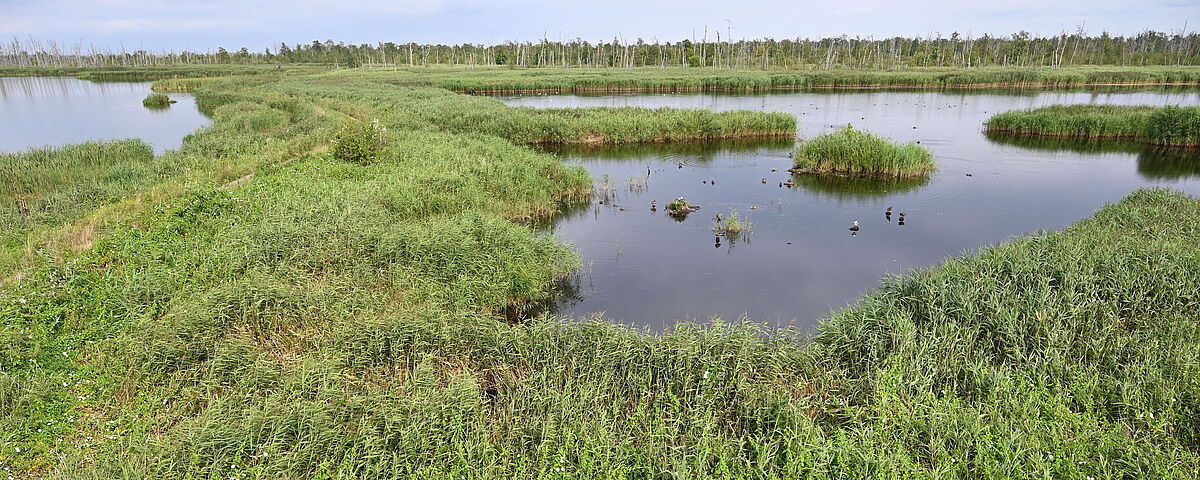
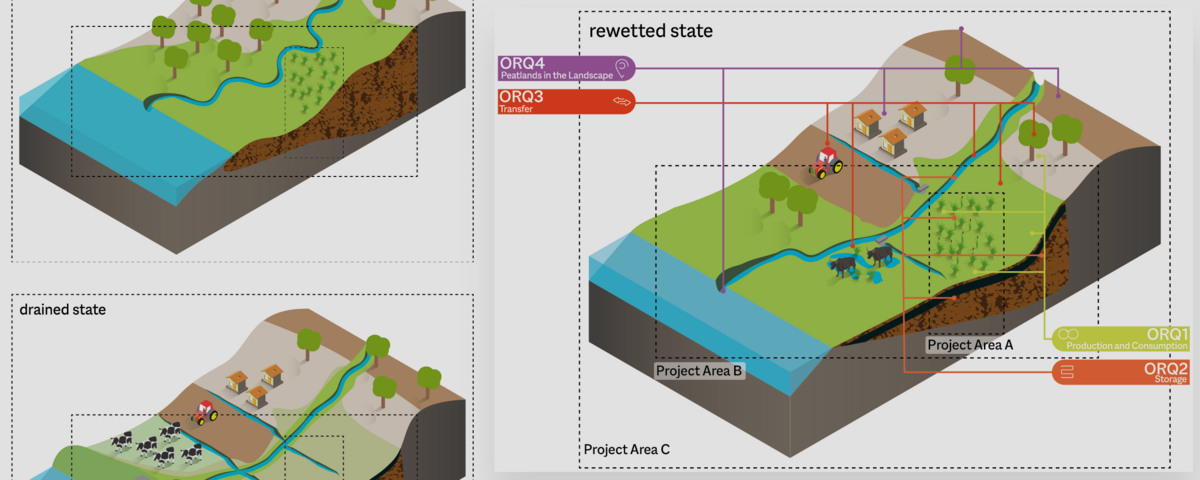
WETSCAPES2.0 is the Collaborative Research Centre/Transregio 410 funded by the German Research Foundation (DFG). It focuses on rewetted fens in North-East Germany that, after decades of drainage, have developed into novel ecosystems: so-called “Wetscapes 2.0”.

The 68-member interdisciplinary research consortium investigates how hydrological, biogeochemical and ecological processes change within rewetted peatlands and how they are linked across space and time – both within the peatlands and beyond landscape boundaries. To do so, WETSCAPES2.0 combines chronosequences, intensive field research, landscape experiments, mesocosm experiments and process-based modelling.

The results provide a functional understanding of these rewetted peatlands. They provide a scientific basis for political decision-making and practical action – from sustainable peatland management to rewetting strategies in line with EU climate targets, including future scenarios such as paludiculture or renaturation.
 

Spokespersons

Prof. Dr. Jürgen Kreyling

Prof. Dr. Nicole Wrage-Mönnig

Scientific Coordination

Jessica Hintze

Newest Publication

Agriculture on wet peatlands: the sustainability potential of paludiculture

Temmink RJM, Lång K, Vroom RJE et al. (2026), Agricultural Systems, 231, 104561.


News from the Collaborative Research Centre

Strong WETSCAPES2.0 Presence at EGU 2026

07.05.2026 – In recent years, the General Assembly of the European Geosciences Union (EGU) in Vienna has become one of the most important international meeting places for peatland science. With a growing number of peatland-related sessions, the conference offered our researchers many opportunities to exchange ideas both within the peatland community and with scientists from across the geosciences.

The WETSCAPES2.0 team contributed to discussions on a wide range of topics, including the ecohydrology of rewetted peatlands, climate feedbacks, greenhouse gas dynamics, and peatland monitoring and restoration.

The team is already looking forward to EGU 2027, where the first results from WETSCAPES2.0 will be presented, e.g. in the session “Paludiculture, Peatland Restoration and Peatland Management”, co-convened by Franziska Tanneberger, and others.

Linked-In Post

Peatlands as Living Laboratories: Students Explore Biodiversity and One Health Research

05.05.2026 – Peatlands in the classroom and in the field! As part of the citizen science project CiFly, students from Alexander von Humboldt Gymnasium Greifswald worked alongside researchers to investigate biodiversity and the occurrence of antimicrobial-resistant bacteria. 

WETSCAPES2.0 supported this year's focus on peatlands through classroom contributions by Prof. Dr. Gerald Jurasinski and scientific coordination by Dr. Kristin Steinfurth. During a field excursion, the students collected environmental DNA (eDNA) samples on rewetted, drained, and paludiculture-managed peatland sites in the Bargischow Polder and Anklamer Stadtbruch, one of WETSCAPES2.0's core research areas.

By actively involving students in scientific research, the project helps bring knowledge about peatlands into society while inspiring young people to engage with science, climate action, and nature conservation. At the same time, participants gain hands-on experience with scientific methods and have the opportunity to develop and explore their own research questions.

Read more: The full press release from the Helmholtz Institute for One Health is available here.

Excursion to Polder Sandhagen: Learning from Research and Experience

23.04.2026 – Together with the  Paludi-MV project we welcomed around 20 participants from agriculture, public administration, environmental organisations and the local community for an excursion to Polder Sandhagen. The site is currently a drained and heavily degraded peatland. Over the coming years, it will be gradually rewetted while continuing to be used through paludiculture – the productive use of wet peatlands.

Prof. Jürgen Kreyling (University of Greifswald) and Dr. Ines Standfuß (University of Rostock) introduced the research taking place at the site and guided participants to several monitoring stations. Since the beginning of the year, researchers have been collecting data on water levels, soil moisture, microclimatic conditions, and greenhouse gas emissions. These measurements will help us better understand how peatlands change during rewetting and provide valuable knowledge for future restoration projects.

One of the highlights of the excursion was the extraction of a peat core around two metres long. Layer by layer, it revealed nearly 3,000 years of peatland history. Plant remains preserved within the peat offered a glimpse into past vegetation, while the different layers showed how the site has changed over time and how drainage has affected the peatland.

The discussions throughout the day were just as valuable as the field demonstrations. Participants shared their own experiences and memories of the polder, adding local knowledge and historical perspectives to the scientific research. One farmer, for example, recalled fertiliser being applied to the area by aircraft decades ago – an unexpected detail that may help researchers better understand the site's history.

Although the monitoring programme is still in its early stages and it will take time before robust results become available, the strong interest and lively exchange made one thing clear: we will be back with another excursion!

All news and activities from the WETSCAPES2.0 Collaborative Research Centre

...at a glance in our news archive.