

Enthusiasm for WETSCAPES2.0 during visit of Mecklenburg-Vorpommern’s Science Minister Martin

20.08.2025 – Bettina Martin (Minister for Science, Culture, Federal and European Affairs of Mecklenburg-Vorpommern) visits the University of Greifswald and learns about ongoing work within the Collaborative Research Centre.
“The fact that the University of Greifswald has succeeded in establishing WETSCAPES2.0 as a new Collaborative Research Centre shows that the research here is conducted at the highest level,” the minister emphasises.
During a guided tour, she gained insights into research on rewetted fens, including a WETSCAPES2.0 experiment with 108 mini-peatlands in the mesocosm facility.
Screening Site Set Up


15.08.2025 – More than 80 screening sites are currently being established in rewetted fens across Mecklenburg-Vorpommern. The aim is to systematically capture sites along different stages of rewetting. To achieve this, multiple teams are regularly out in the field, installing measurement infrastructure and collecting key data on water levels, peat characteristics, and microbial communities. The setup of the sites is preceded by extensive coordination with authorities and landowners.
The data collected provide a key foundation for understanding the impacts of rewetting.
International exchange on peatland research with UK Ambassador
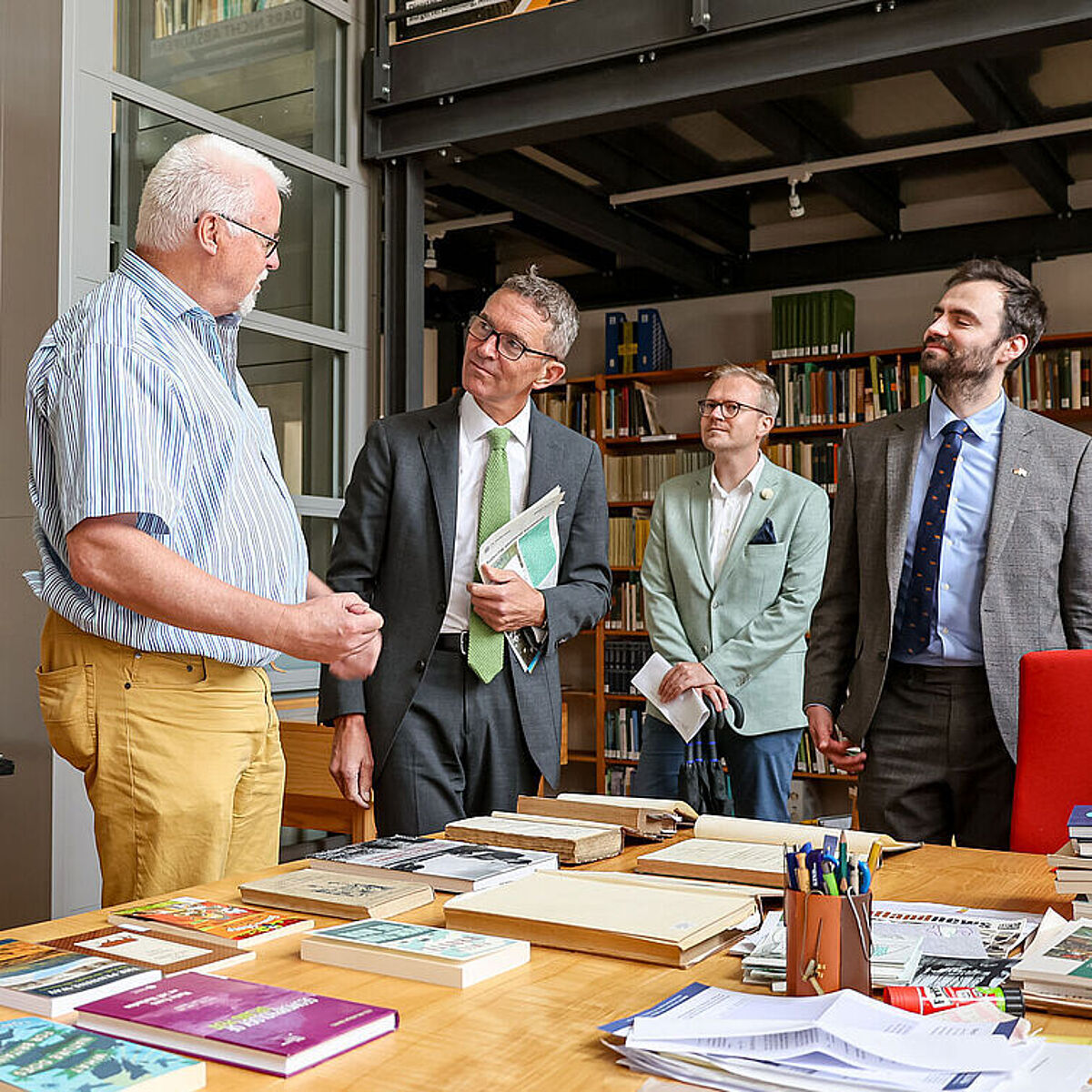
01.08.2025 – During a visit by UK Ambassador Andrew Mitchell to the University of Greifswald current developments in peatland research are presented: including the Collaborative Research Centre WETSCAPES2.0.
The exchange highlights the international dimension of research on rewetted peatlands and points to opportunities for future collaboration and knowledge transfer.
Peatland research in focus during Federal Environment Minister Schneider’s visit

04.07.2025 – Federal Environment Minister Carsten Schneider visits the Greifswald Mire Centre to gain insights into current research approaches to peatland rewetting. The visit also highlights ongoing work and future perspectives being developed within WETSCAPES2.0.
The focus of the visit is on methods for measuring plant biomass and greenhouse gas fluxes, as well as investigations of peat properties and key topics such as paludiculture, biodiversity, and peat formation.
Erstes Mesokosmos-Experiment gestartet (Kopie 1)

04.06.2025 – Konsortiumsmitglieder richten in der Greifswalder Mesokosmos-Anlage das WETSCAPES2.0-Experiment „Rewetted Peat“ ein. Untersucht wird, wie wiedervernässte Niedermoore auf extreme hydrologische Ereignisse wie Trockenperioden und Überflutungen reagieren.
Dafür wurden 108 Mesokosmen mit Torf befüllt und mit den Pflanzenarten Phragmites australis, Carex acutiformis und Carex rostrata bepflanzt. Parallel erfolgen Probenahmen zur Analyse mikrobieller Prozesse.
In dem kontrollierten Experiment werden bis ins Jahr 2026 unterschiedliche Wasserstände und Extremwetterereignisse simuliert. Damit wird ein wichtiger Datengrundstein für den Sonderforschungsbereich gelegt.
Partners visit Polder Fuhlendorf

04.06.2025 – Members of the consortium meet with the Ostseestiftung and the Leibniz Institute for Baltic Sea Research Warnemünde (IOW) for a joint field visit to Polder Fuhlendorf. The drained coastal peatland is part of the ANK-funded project “Climate Protection in Coastal Peatlands” and is set to be restored through dyke realignment. Within WETSCAPES2.0, the site will be accompanied as a landscape-level experiment during this transformation.
The visit focused on aligning key research questions and preparing upcoming fieldwork. Discussions included the installation of measurement infrastructure and processes at the interface between peatland and coastal waters.
Kicking off WETSCAPES2.0
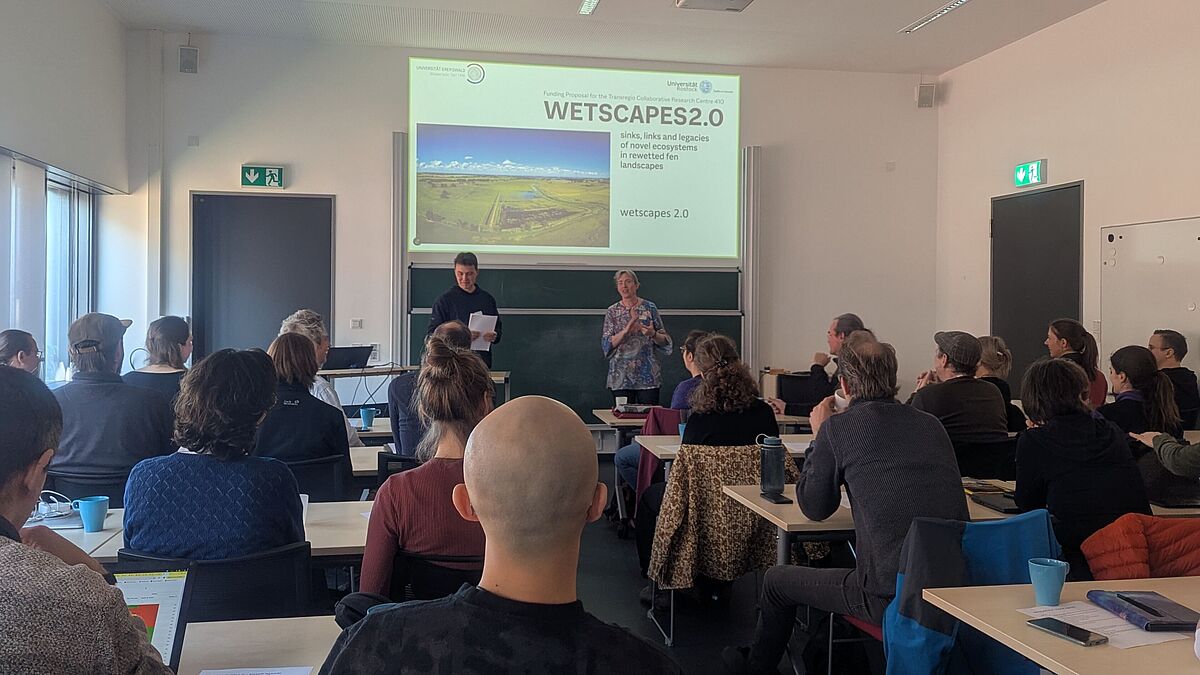

03.04.2025 – The Collaborative Research Centre officially started with a two-day kick-off meeting at the University of Rostock. More than 50 researchers from the eight partner institutions took part, including a large number of early career researchers. The meeting brought together researchers from across disciplines and marked the starting point for collaboration between the subprojects. The range of expertise involved highlights both the interdisciplinary nature and the complexity of the research programme.
A key element of the programme was a field excursion to one of the screening sites, where the first sensors for data collection on rewetted peatlands were installed - initiating the planned monitoring network of approximately 1,000 sensors.